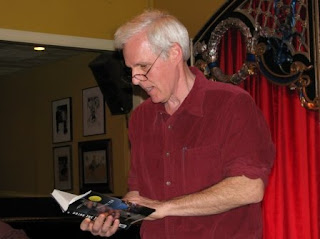
One of my favorite events during Longmire Days was a session with Craig Johnson at the Johnson County Library called "So You Want to Write a Mystery." When I spoke to Craig afterward he said that he had hoped it could be more of a workshop-type event, but that didn't happen. However, it was still incredibly successful as they packed the library, possibly to the point of some fire code violations? Who knows.
 |
| Johnson County Library building |
 |
| A statue outside the library that attracted my attention. |
Craig arrived a little early and he informally started taking questions which set the tone for the entire session. After having attended many author events, some questions have become slightly tiring to me (who proofreads your books? who writes the copy for the dust jackets?--thank God no one asked where he gets his ideas!) but again, I attend a lot of these things and these types of questions simply don't interest me...unless of course there's some cool story to go with them. "Well, I'm glad you asked, President Obama actually proofreads my books because years ago we had a bet..." (of course Craig did not say that). And you know, you really have to give kudos to the authors who have to repeatedly discuss things like that. But....
There were great questions and great discussion in the session as well.
Craig shared with the group that when he started writing he was advised
never to do three things:
1.) give your characters a pet--because then you have to take care of it. Craig said he manages a ranch, writes books and is still able to take care of all his animals, so he thought Walt aught to be able to handle one dog. His alternative was to have an armed man driving alone all over Wyoming talking to himself...it's much better he has his dog to talk to.
2.) take your characters to a new setting. Well in book three, Craig takes his characters to Philadelphia.
3.) have your characters hook up--sexual tension is o.k., but no follow through. And of course in that same book three, Craig writes his famous three-sentence sex scene.
The point of his story, though, was never let someone else tell you how to write your book. Write the story you want to tell.
For Craig (as I've heard some other writers mention) there is no "literary" and "genre" fiction. There aren't various different types of genres, but there
are two categories: good writing and bad writing. Craig aims for the good with each book he writes. Craig enjoys investigating Walt and his character and trying a new approach with each book. His aim is less to write a book than to have his reader feel like they've just walked up to the bar, taken a seat next to Walt and had him turn to them and say, "let me tell you a story." Then the reader falls into that story along with Walt.
When Craig was asked which character he most enjoys writing dialogue for, he said it is all dependent on his mood. I'll let you guess who he likes to write when he's in a foul mood...
In the realm of where do you get your ideas....Craig shared that the real-life Dorothy (from the Busy Bee) gave him the inspiration for
Death Without Company. As he was battling with ideas about the book, going back and forth about motivations, she got fed up and said to him, "if you want to know why a man is the way he is, find the woman in his past." That set off all the triggers and away he went.
A popular question for Craig: "why did you choose Rainier Beer?" He says not a week goes by that he doesn't get an inquiry as to why he has Walt drink that awful beer. Craig says Walt just isn't a "microbrew, blueberry beer kinda guy." He wanted a blue-collar type beer. Budwiser and Coors didn't need any help from him, so he went in search of something that reflected the West. Ultimately he ended up with Rainier (which incidentally, was a big sponsor of the Longmire Days!).
Another question for Craig--less about writing, more about the television show--does he want to appear on the show. Craig has been asked by the staff every time he's on the set if he'd like to appear in the show and he says he isn't interested. He likened it to the scene in Field of Dreams when Moonlight Graham crosses the line and knows that life isn't ever going to be the same. Craig says he's just not "of that world."
And that question is a great lead-in to the first guest to join the session. Robert Taylor arrived about mid-way through and the audience had plenty of questions for him as well. The ease with which Taylor and Johnson joked reflected a special connection between the novel writer and the actor that I would think is rather rare in instances like this.
Robert Taylor explained that he has read
The Cold Dish but had to stop at that book. Once the show has run its course, which he hopes won't be for awhile of course, he plans to read all of the books. But allowing Craig's Walt Longmire to seep into his brain would cause problems because it isn't the same Walt that the show's writers have created. So in order to keep them separated, he refrains from reading the books...right now.
Taylor was also asked how he got into acting. His response, "I literally fell into it." Taylor originally wanted to be in the Navy and he did enlist. But when a fall on his ship put him in the hospital, he happened upon a casting call in the newspaper he was reading. He answered it and the rest is history. Of course his wide geographical resume has confused his accent quite a bit. He claims he's pretty much lost track of it after all the work in the UK, playing a drunk Irish priest, his work in the US and others.
And as if two major speakers at this session weren't enough, Hunt Baldwin, a writer and executive producer for the show, also joined in. He received an inquiry about when they were going to have Dog join the cast. To which he informed the audience that's one of the most common questions they get for the show. They'd like to add Dog, but he said don't hold your breath.
Of course, being in the real-life Durant, locals wanted to know why all the filming for the show is done in New Mexico. Essentially it comes down to money and weather. New Mexico already has sound stages and crews in place (Wyoming has none of either), there are tax credits involved and they can film in March.
Like Taylor, the writers on the show have all read
The Cold Dish. Beyond that, some have read all the books, some only
The Cold Dish and others somewhere in between. A lot of what determines that is the individual writer's approach to research.
Another question for Baldwin was how far ahead the staff writes. The answer: in March they are way ahead and by June they're about a day and a half ahead.
Craig doesn't envy the TV writers. Their scripts have to be 42 minutes long--not 42 minutes and 13 seconds, 42 minutes period. For Craig, that's like writing haiku. He says another drawback is that the sponsors tend to infringe on those 42 minutes. His example was Dodge. With the exception of Walt's truck, the cars on the show have all had to transition (through on scene accidents and such) to Dodge vehicles.
And of course the question of renewal came up for the television show. The three representatives explained that the hold-up is actually a battle between A&E and Warner Brothers. Each has claims to different revenues from the show. But due to its success each wants in on parts of the other's now, so the battle isn't about the popularity of the show (well, indirectly it is) but it's about the executives duking out the profit distribution (sound familiar?).
 |
| The stars were put to work signing after the session. They had A LOT to sign! |
This session was absolutely fascinating and I think I could have spent an entire day listening to Johnson and Baldwin talking about the different facets of their writing mediums and the different approaches they call for. Their humor, authenticity and candid responses made this one of the big highlights of my trip. I hope I did it some justice for you today. I'll leave you with my wonderful picture with Robert Taylor. Many thanks to a new friend, Diana, who snapped the shot for me.
If you missed my previous writings about my Longmire Days adventure, you can find my
literary tour of Buffalo (a.k.a. Durant) here and my
overview of the weekend for Criminal Element here. There will be a couple more articles here at the blog in the coming days.




 After explaining that these two stories provided the foundation for her plot, Alafair read an excerpt from 212 that introduces Megan, a character who gets caught in the intersection of these two plot influences. Here is a video of Alafair's reading:
 Alafair feels that she has more liberty as a writer because she doesn't write full time. Whereas a full-time writer is dependent on his/her book selling so that the rent can be paid, so that he/she can eat, Alafair doesn't have those concerns. She has a regular income with her teaching job and so the rent is paid, the groceries are in the cupboard. But if she had the stresses of worrying about selling the next book, snagging the next contract, then she'd be far more likely to be stifled as a writer; she wouldn't be able to focus on what will make the best book but rather what does the reader want? what can marketing sell? And Alafair also points out that she enjoys her job as a law professor. She isn't trying to write her way out of that job like some others may be doing.
 I learned about the writer Alafair Burke when I started reading her books. I fell in love with her style and characters and quite frankly, everything about her books. Through book events and interviews I was fortunate enough to meet the person, Alafair Burke, who I admire tremendously and absolutely adore. These days it is a true honor to say, "this is the writer Alafair Burke; she's also my friend." Thank you for letting me share her with you today.