Showing posts with label book tour. Show all posts

Thursday, June 28, 2012

Angel's Tip - Alafair Burke

I was asked to be on Alafair Burke's Angel's Tip blog tour for the new release of a trade paperback version of the book. My opinion of Angel's Tip hasn't changed since I read it and reviewed it when it came out in hardcover in 2008.

So, since you can already read my previous review, I wanted to do something different and fun for this blog tour stop. The second book of the Ellie Hatcher series is like the other books in that its title has various layers of meaning. The most surface layer is the name of a cocktail. The novel's victim, Chelsea Hart, is drinking Angel's Tips at the bar the night she goes missing.

If you asked Alafair Burke what she thinks of the Angel's Tip, she'll tell you, "it's gross." The drink is made by mixing equal parts creme de cacao and heavy cream. As a garnish, some recommend a maraschino cherry and others recommend a mint leaf. I don't think either garnish is going to improve the drink's standing, however.

If you want to score points with Alafair, skip the Angel's Tip and go for Bombay sapphire gin, up. And how about Ellie? Who knows Ellie's drink of choice?  Since I'm going to see Alafair in a couple of weeks, I'll make this a contest! Tell me in the comments what Ellie's drink of choice is and I'll toss all the correct answers in a hat and pick a winner. The winner will receive his/her choice of a book by Alafair and I'll have it personalized for you when I see her!

Since I'll see Alafair on the 11th, I'll take entries until the end of the day on the 8th and contact the winner to see what book he/she would like and how they would like it signed. I'm in a generous mood because it's Alafair Burke, so I'll take entries from anyone anywhere the mail will deliver!

In the mean time, check some of the other bloggers that are talking about either Alafair's NEVER TELL, which I reviewed last week, or her NEVER TELL/ANGEL'S TIP tour. If you haven't read ANGEL'S TIP, be sure you stop by and see my review. The book is now available in trade paperback (ISBN: 9780062114235) from Harper with a snazzy new look. There is also a Recorded Books version available for my audio fan friends. It's narrated by Eliza Foss.

Alafair is still on book tour, so you can get reports from the road via her Facebook page or her Twitter account. You can also join her live webchat on July 16th at 9pm Eastern.

If you missed Alafair's Five on Friday last week, stop by and find out what her biggest pet peeve is!

Drink your liquor in moderation, drink your crime fiction to your heart's content and always be safe. I want you to continue talking books with me. Happy Reading!

Wednesday, June 20, 2012

GONE GIRL - Gillian Flynn

First line: "When I think of my wife, I always thing of her head."

Nick Dunne was a young magazine journalist in New York City when he met his wife Amy. Amy was also a writer. She wrote psychological quizzes for magazines. You know, the kind you find in Cosmo asking you how you would respond in a hypothetical situation and your answer is a reflection of your personality. Amy is also the daughter of a hugely famous writing husband and wife team who made their fortune and fame writing a children's series called, "Amazing Amy."

Amy came from a privileged background and Nick was a handsome, charming, ambitious young man from the Midwest. But neither Nick's charm, nor Amy's privilege could save them when the publishing industry started to fail and they both lost their jobs. Then when Nick's mother was diagnosed with cancer, he and Amy moved back to his small hometown in Missouri.

On the day of Nick and Amy's fifth wedding anniversary, Nick came home to find the door open, the cat on the front porch and his wife gone. The iron was left on and there appeared to be a struggle in the living room. When the police begin investigating, the skeletons start tumbling out of the closet.

Before you open up GONE GIRL, check your expectations, pre-concieved notions and theories at the door. Gillian Flynn will challenge everything you think you believe as you read this addictive psychological thriller. GONE GIRL alternates between Nick's recounting of the criminal investigation as it happened and Amy's diary entries preceding her disappearance. I began to recognize a story line as "ripped from headlines" and just as I became confident, cocky about figuring the book out early, Flynn "ripped" the rug out from under me.

In addition to placing perfectly timed twists in the plot, Flynn builds up the reader's passion for characters - passions both good and bad. Then she challenges what the reader thinks he/she knows. Appearances can most definitely be deceiving and piece by piece Flynn tears away at the security of certainty. After the first major plot twist, I found myself bracing the rest of the novel, waiting for just about anything to happen.

GONE GIRL runs over 400 pages, but readers will find the end far sooner than they expect; fear not, though, the story will linger in readers' minds for days afterward. It's haunting, it's dark and it's deliciously wonderful.

I have no doubt that Gillian Flynn will go down as one of the great crime writers of this generation. She is a natural story-teller and knows precisely how to hook her readers. She sets the bar far beyond what most will ever reach. It's story-tellers like her that cause readers to be disappointed in decent books. Once you've experience exceptional, it's hard to settle for less.

GONE GIRL is certain to be among my favorite reads of 2012.

GONE GIRL is available in hardcover (ISBN: 9780307588364) from Crown Publishers. It is also available from Random House Audio as an unabridged audiobook (ISBN: 9780307990402) narrated by Julia Whelan and Kirby Heybourne. Random House Audio had this excerpt available so I thought I'd include it for my fellow audiobook fans:
My review is part of the TLC Book Tour for GONE GIRL and I'm very excited to have the opportunity to give a copy of this great book away. So if you would like to put yourself in the running, just answer my psych quiz in the comments section (be sure I can email you if you win). Here it is:

You are going to your favorite bookstore today, do you:
a.) go with no idea what you're going to buy but you'll ask the employees for a good recommendation
b.) go knowing the owner has already set aside a new recommendation for you because he/she ALWAYS has one at the ready for you - afterall, you're on a first name basis with him/her
c.) head directly for the bestseller shelf and grab the NYT #1 book for this week
d.) take your wish list that's a mile long and spend three hours trying to figure out which new books you'll take home

Winners must have a mailing address in the US or Canada and it cannot be a P.O. Box. Sorry folks. I'll take responses until Sunday at midnight (Eastern) and I'll draw a winner on Monday.  If you'd like to see what other bloggers on the tour thought about GONE GIRL, check out the TLC website for the complete list of participating bloggers.

Happy Reading!

Tuesday, February 28, 2012

THE TECHNOLOGISTS - Matthew Pearl

First line: "Its proud lines intermittently visible through the early morning fog, the Light of the East might have been the most carefree ship that ever floated into Boston."

In Boston, 1868, The Massachusetts Institute of Technology is preparing to graduate its first ever class of seniors. The esteemed MIT of 2012 is not the same institution of 1868. In 1868 MIT is struggling to prove its worth next to the time-honored traditions of Harvard and the taboos connected with "technology." The unions are opposed to "Tech" because they fear the resulting loss of jobs if engineers, chemists, physicists, architects discover new and efficient ways to do the work physical labor has always provided. The traditionalists of Harvard see Tech as unworthy because of the lack of humanities and lack of God. And as is human nature, everyone fears what is new and unknown. So the Massachusetts Institute of Technology has to prove itself at every turn.

In the midst of MIT's struggles for recognition, a catastrophe sieges the Boston harbor. On a fog-filled night, ships coming into and going out of the harbor suddenly find their compasses have all gone haywire, spinning bizarrely out of control. The result is massive destruction as ships crash into each other and the piers. At first it is written off as a freak of nature phenomenon. But when that event is followed up by an incredible melting of glass throughout the business district, a police investigation sets out to uncover what or who is causing all the mayhem. The Boston Police Department opt to recruit the head of Harvard's science department in their investigation, and the Board at Tech decides to stay completely out of the case to avoid any bad publicity. But a group of Tech seniors and the first female Tech student - dubbing themselves "The Technologists" - decide they have to disregard the mandate and probe into these strange and devastating events. The future of MIT could depend on their success, but someone is determined to stop them one way or another.

THE TECHNOLOGISTS embodies all the characteristics of great historical fiction as well as great thriller writing. The authenticity of the time period comes through in the setting as well as mannerisms of the characters. The strength of the research is evident in the detail, while still leaving enough to the fictional plot.

The storyline includes several well placed twists, and despite its almost 470 pages, the pace is swift and the plot is tight.  As Pearl adroitly blends the historical novel with the thriller, so does he blend themes of man and nature. He challenges perceptions in much the same way MIT did at its birth:

"That is technology - our way to become closer to being like the animals."

"I believe the scientific arts represent the mind of God better than any other human endeavor."

And most poignantly, Pearl shows the double-edged sword of technology. Through the tragedies of Boston as well as flashbacks to the Civil War, he exposes the evils that are equally possible.

The characters are the true gems of this novel, however.  Pearl's "Technologists" each have their own role, blending unique qualities with some stereotypes. But before you jump to conclusions about my use of the word stereotypes, let me further expound that the blending makes the characters rich, humorous and convincing.  His inclusion of Miss Ellen Swallow is especially significant. Swallow is brilliantly depicted, but she also serves to reflect the ingenuity of MIT at the time as well as adding a vital element to the dynamics of the relationships among the "Technologists."

THE TECHNOLOGISTS wasn't written, it was crafted - and beautifully so. Like the architects and the engineers he writes about, Matthew Pearl constructed a treasure. This is a novel to re-read at least several times to absorb all the layers and subtleties.  THE TECHNOLOGISTS is enlightening, it's entertaining and it's story-telling at its best.

THE TECHNOLOGISTS is available now in hardcover (ISBN: 9781400066575) from Random House and for my audiobook fans, it's is also available in unabridged audio (ISBN: 9780739344309) from Random House Audio, narrated by Stephen Hoye.

My review today is part of the TLC book blog tour. You can check out the other blogs who have reviewed THE TECHNOLOGISTS and see what they have to say about it.

I also encourage you to read Matthew Pearl's short story, "The Lady in the Basement," about Ellen Swallow - taking place prior to THE TECHNOLOGISTS - that he published in five parts at the Five Chapters site. Because I found myself constantly running to Google to check on historical elements of the book, I also especially liked this article Pearl wrote about research he did on MIT pranks. Yes, I've been a tad bit consumed by this book. If you enjoy it half as much as I have, you'll get your money's worth and then some.

But, I'll foot the bill for someone here to read it. Well, actually, I'm not footing the bill on this one. But, I do have a copy to give away to a lucky reader (sorry US/Canada residents only on this one). For your entry in the giveaway, just tell me in the comments one technological invention you're very happy you do not have to live without. I'll pick a winner from the entries on March 9th. Good luck...and happy reading!

Tuesday, February 14, 2012

PRIME SUSPECT - Lynda La Plante

First sentence: "Mrs. Corrina Salbanna was woken from a deep sleep by the sound of the front door banging in the wind."

Jane Tennison is the only female Detective Chief Inspector in the murder squad at Scotland Yard, and the old boys club isn't any too happy about it. They've managed to keep her out of the murder investigations so far, but when Detective Chief Inspector John Shefford dies of a massive heart attack, there's no option but to let Tennison take over the investigation of a murdered prostitute. What Shefford's team was touting as an open-and-shut case turns out to be far more than that. Tennison finds holes in the investigation and the team is forced to release their prime suspect. But Tennison is bound and determined to close this case and securely nail the guilty party, no matter what it might cost her personally.

Lynda La Plante makes a bold statement with PRIME SUSPECT. Not only is she portraying a woman who has to battle the "old boys school" of law enforcement, she's portraying an ambitious woman trying to climb the ladder. And that character isn't always the most lovable character. As readers we want to see a lot of the stereotypes our society reinforces: the female "fixer" who makes everyone happy, the discreet affair between a male and female in the department that makes everything work out in the end. Tennison doesn't have any of that. She has aspirations of where she wants to go in her career. Standing in her way, she has a department that will fight her over her ambition and a significant other that doesn't understand or support those aspirations when it isn't convenient for him.

There were times when I wanted to throttle Tennison. "Really? You're making that choice?" But as I digested it more I realized those choices made her deliciously human. I have a list of decisions a mile long that I look back on now: they seemed like the right choices at the time, but now all I can say is, "what WAS I thinking?"

I appreciate La Plante's willingness to portray the no-always-so-likable female climber. I'm not sure I'd want to work with Tennison, but I can appreciate her struggles. The other underlying implication is the hypocrisy of the system. La Plante does a fine job of intimating it, without letting it interrupt the plot.

The plot of PRIME SUSPECT is tight and well-developed. La Plante builds anticipation with each chapter and keeps the pace moving swiftly.

Not much has been changed in the way of local colloquialism. I found myself having to figure out some phrases and idioms that are not common in the U.S., but that also lent itself to appropriate atmosphere.

I enjoyed PRIME SUSPECT and look forward to following Jane Tennison on to her next appearance in La Plante's series.

PRIME SUSPECT was originally published in the UK in 1991. It has been re-released this year in the U.S. in trade paper (ISBN: 978-0062134370) by Harper Collins.

My review is part of a TLC blog tour for the PRIME SUSPECT three-book series. You can see other reviews and their thoughts on the books by checking the TLC tour page.

Tuesday, July 5, 2011

THE HONORED DEAD - Joseph Braude

First line: "Muhammad Bari eased out of his bedroom and opened the creaking front door just enough to make his way outside."

THE HONORED DEAD: A Story of Friendship, Murder, and the Search for Truth in the Arab World is the non-fiction account of Joseph Braude's investigation into a murder while he was embedded with Casablanca's National Security. Joseph Braude is a Jewish-American journalist and he was given the file on the murder of a homeless man in a warehouse. He was given the file to illustrate how well the National Security was doing its job. As Braude spoke to people who knew the victim, he discovered Muhammad Bari. Bari believed there was more to know about his friend's murder and he recruited Braude to help him find out exactly what happened.

THE HONORED DEAD took some adjustment for me as a reader because I'm typically a fiction reader these days. I quickly remembered that reading non-fiction is a much slower endeavor for me. While THE HONORED DEAD reads somewhat like a murder mystery, it still exhibits elements of non-fiction, such as deviations to explain cultural information, background information, history, etc. There is also an important layer to the book that deals with Braude's own history, so there are times when he deviates to explain his personal story. All of these items are important to understand the journalist's perspective and the actions of the people involved in his investigation. But it does have the effect of slowing down the reading experience.

This book was at turns fascinating and terrifying. For me it was somewhat of a reminder of my sorely deficient knowledge of world events. And it is still a jolting experience for me to be reminded of how women and underrepresented populations are treated in these cultures. The irony being that the National Security is trying to show Braude how advanced and progressive they are. Change is a very slow process when it involves culture.

THE HONORED DEAD is a book that I believe is very dependent on the reader. I was moved by Braude's vision of the people he encountered. His cultural background mixes Judaism with his mother's Iraqi heritage. Braude is American by birth and studied Near Eastern cultures in college; his best friend was Muslim. This diversity allowed him to have somewhat of a connection with most everyone he encountered. And similarly, his bad experience with law enforcement in the United States influenced his perceptions of law enforcement in Morocco as well. I felt a great deal of empathy for many of the people Braude illustrated. I would be curious to know how someone from the Muslim culture or the Jewish culture would see these same people through these same words. Would Braude's effect be similar? What the reader brings to this book plays a huge role in its tenor.

THE HONORED DEAD is an eye-opening experience in it's portrayal of Morocco and it's people.

THE HONORED DEAD is available in hardcover (ISBN: 978-0-385-52703-3) from Spiegel & Grau.

My review is part of the TLC Blog Tour for THE HONORED DEAD. You can check the site here for additional reviews of this book as well as additional information about Joseph Braude. You can also find out more about Joseph Braude and THE HONORED DEAD at his website.

Monday, January 17, 2011

LOVE ME TO DEATH - Allison Brennan

First line: "This was Roger Morton's big chance - his only chance - to get out of the country and re-create the life he used to have."

Lucy Kincaid is a rape survivor trying to join the FBI. As she works through the steps to attain her goal - impressive collegiate accomplishments and internships - she is also volunteering at a victims' rights group. Lucy has created a program to track released rapists who are at risk for repeating their crimes. She finds them online and sets up stings to take the offenders down and off the streets. However, when one of the offenders doesn't show at the arranged location and instead winds up dead in another location, the cop who was sent to arrest the rapist questions Lucy. When Lucy starts digging into the matter, she discovers this isn't the first man she's set up to turn up dead instead.

Meanwhile, one of the men responsible for Lucy's rape six years earlier has been released from prison. When he too winds up dead, the FBI is at Lucy's door searching for answers.

LOVE ME TO DEATH has a strong, suspenseful plot with well-timed twists. Brennan does a great job of giving just enough information to adequately tell the story but leave some vagueness that in turn creates questions and momentum.

The characters are well developed. Lucy is a strong female lead with realistic qualities. She has fears and doubts and desires but is resilient, smart and determined. Likewise, her sister-in-law Kate is talented and smart. I enjoyed the verbal sparring between Kate and Special Agent Noah Armstrong, contrasting and comparing the sexes and their obstinacy.

Sean Rogan is Lucy's love interest as well as her brother's partner in a security agency. He's young and full of testosterone. I think Brennan intends for his character to grow and mature in his relationship with Lucy and the dangers they're encountering, but it sometimes came off as a little overly dramatic and not so believable.

The main villain of LOVE ME TO DEATH is a 100% evil, creepy sociopath. Readers will not have any conflict about their feelings for this character.

As I'm a proponent of less is more when it comes to sex and violence, I think the "romantic interludes" were far more detailed then they needed to be and lost a lot of their effect in addition to slowing the plot at points. But if you're a fan of the romance, this element won't be an issue for you.

Finally, I was a little disappointed in the outcome, which I, of course, will not share. Part of the resolution I figured out early, and part was anti-climatic after all the suspense Brennan built up throughout the book. The book is so chock full of great elements that challenge the reader, and I wanted the end to be at that level as well. You know, one of those, "Wow! She really got me on that one."

That being said, it was a very enjoyable, fast read. Fans of romantic suspense will likely fly through the pages to find the resolution.

LOVE ME TO DEATH is available from Ballantine Books in paperback (ISBN: 978-0-345-52039-5). And this review is part of the LOVE ME TO DEATH blog tour, arranged by TLC Book Tours. You can find other reviews of this book at the TLC site.

Friday, October 8, 2010

INNOCENT MONSTER - Reed Farrel Coleman

FIRST LINE: "Katy's blood was no longer fresh on my hands and after 9/11 people seemed to stop taking notice."

Moe Prager returns in his sixth book of the series. This time around his daughter Sarah breaks her estrangement with Moe to ask him for help finding Sashi Bluntstone, the missing daughter of her childhood friend. Sashi is eleven years old and has been missing almost a month when Sarah approaches Moe. Sashi also happens to be a great art prodigy who has been painting since she was four years old. The time elapsed since her disappearance coupled with the publicity of the case make it less than appealing to Moe, who hasn't worked a case in six years. But his desire to have his daughter back in his life drives his decision to try to find Sashi. As Moe dives head first into the New York art world, he discovers an inordinate amount of ugliness in a realm that is supposed to celebrate beauty.

Every book in the Moe Prager series has left an imprint on my reading soul. INNOCENT MONSTER may very well have left the biggest and strongest of those imprints. Few series have consistently had such a strong effect on me as a reader and as a person. But with Reed Farrel Coleman's award-winning series, that effect isn't a result of the plot ideas themselves but more Coleman's style of writing and his approach to those plot ideas. 

Moe is a series character who is not only searching for lost people but he's searching for his own identity. In INNOCENT MONSTER we're seeing him come more to terms with that identity. And Moe is written in such a way that the reader can't help but look at him/herself as Moe makes his self-discoveries. That's a pretty powerful connection between reader and book. Which in turn pulls the reader into the story more as a participant than as an outsider watching what's going on.

INNOCENT MONSTER is populated with a multitude of wonderfully colorful, rich characters who have been affected and shaped by their environments. All of that dimension comes through whether the character appears once or a hundred times in the novel. Coleman says that each person is the center of his or her own universe. Even though INNOCENT MONSTER is written in first person from Moe's perspective, Coleman still manages to take us to the center of each character's universe. While we may not always agree with a character's motives, we can understand them and thereby better understand the characters. The other task this accomplishes is painting each character as a possible suspect. Then the journey through the plot becomes a house of mirrors.

The plot of INNOCENT MONSTER is daring and powerful. Coleman has shown that he isn't afraid to venture into sensitive subject matter. He also isn't afraid to go against the grain to achieve his goal. Steeped in complex themes and moving symbolism, INNOCENT MONSTER is a timeless tale of humanity.

The Moe Prager books are ones that I know I will re-read many times because there is so much to digest in every part of every book. As with the previous books in the series, at the conclusion of INNOCENT MONSTER I found a plethora of ideas and situations and questions spiraling around in my head. There was much I wanted to process and ponder. Questions I was asking myself. This is simply not a book that will leave you alone once you've finished it. Those are the best kind.

INNOCENT MONSTER is available in hardcover (ISBN: 978-1-935562-20-7) from Tyrus Books.

Technorati Tags: , ,

Wednesday, October 6, 2010

More One-on-one with Reed Farrel Coleman

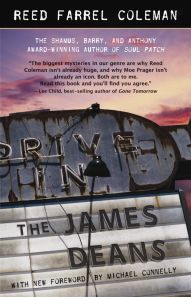
Welcome back! Today Reed Farrel Coleman and I are talking more about the Moe Prager series and his newest Moe installment, INNOCENT MONSTER. Before we get back to the interview, I just have to say that this is one of the coolest book jackets. Not only is it aesthetically wonderful, but I think it captures the essence of the book. That doesn't happen all the time so I wanted to give some kudos to Kristie Langone of 2Faced Design. Seems as though she really understood what Reed was doing. O.k., so enough for my sidebar. Let's get back to this interview because I want to hear what Reed has to say:


Q. The Moe Prager books have a rather unique story arc that spans the majority of the series. The skeleton of that arc makes up WALKING THE PERFECT SQUARE and then subsequent books fill in that skeleton. Was that your plan when you wrote WALKING THE PERFECT SQUARE or was it originally meant to be a stand-alone novel?

Reed: Who knows what I meant to do? Although my family and friends will tell you I am a good planner, I don’t do any planning in my writing. I see what comes and work with it. It’s what makes writing exciting for me. God, I would be so dreadfully bored by outlining and doing story arcs and timelines. Frankly, I don’t know how people do it. While writing WTPS, it occurred to me to break some rules. I’m from Brooklyn, it comes naturally to me. I decided to let the readers know more about what would happen to Moe than Moe would in subsequent books. For the reader it would be like seeing the train approaching the car stuck on the tracks, but the guy in the car not seeing the train at all. It’s a thing Alfred Hitchcock used to do. He’d show the audience the ticking bomb but not the characters. Of course once I did that I had to figure out how to make a series of the book when the audience knew what was coming. **PARENTAL WARNING: AUTHOR BRAGGING TO FOLLOW** Given that the series has garnered three Shamus Awards, the Barry and Anthony Awards, two Edgar Award nominations, two Macavity nominations, two Barry nominations, and a Gumshoe nomination, I’d say I managed to make it work.


Jen: Uhm, yeah, I'd have to say you did just that.

Q. Moe has, throughout the series, lived his life in the past. The constant reminder of his secret hanging over him for years and years; his desire to have the gold shield he earned but didn’t receive continued to control him. But in INNOCENT MONSTER, Moe seems to be moving more toward the future and living in the here and now. He’s trying to straighten out his relationship with Sarah, and he’s looking toward a new relationship, being open to that idea. Throughout the series Moe has evolved, grown, he’s been affected by the events that have transpired in his life. Do you find this essential in a series? Not all series characters change. So what are your thoughts on that and why did you decide to have Moe grow, age, change?

Reed: Moe changes because people change. One of the traditions of detective fiction that I have always loathed is what I think of as the Next! conceit. That’s where one client, having received the news about the resolution of a case, leaves the office as the next client comes in. Hate it. Hate it. Hate it. I’m not interested in super heroes, archetypes, or cardboard cutouts. For me to be interested in writing a character, the character has to be a human like the humans I know. They don’t become vampires or werewolves or zombies or have unlimited ammo or possess super powers or ridiculous powers of observation. The humans I know age and change. Their lives are full of joy and grief, of highs and lows. They face a slog every day just to get out of bed, raise their kids, and earn a few pennies. As Moe ages, he can see the end in sight. That’s a powerful thing, let me tell you. As my wife said to me last night, “I remember when I read about characters in mid-life, I used to think they were like a different species.” Well, having reached the ripe old age of 54, I can tell you you begin to see the end in sight. It probably won’t make Moe find religion, but it has a profound effect on him. I want readers to know this Moe too. Yet even as we change, we are essentially the same. It is the pull between these two things I find fascinating about life and characters.

Q. One of my favorite characters in INNOCENT MONSTER is Declan Carney. He’s incredibly symbolic, and of course, he’s pivotal to the plot. Is Declan a creation of your imagination or was he inspired by someone?

Reed: Well, his first name is sort of an homage to my Irish buddies Declan Burke and Declan Hughes, but he isn’t inspired by anyone at all. He’s symbolic of the kinds of damage and punishments humans inflict upon each other, but especially upon themselves. Carney is meant to sound like carnage. He is also meant to represent the tragedy of how we ignore the damage done to returning veterans. Whether you agree with our military policies or not, you have to feel for these people whose lives have been changed forever.

Q. Declan is also an example of how every character is rich and fully developed, no matter if they show up once a book or once a page. Obviously that’s important to you as a writer, so why is that? If they’re a minor character, why do they need to have such dimension?

Reed: There is no such thing as a minor character, because there are no minor human beings. Whether we want to admit it or not, we see ourselves at the center of the world. So Declan Carney is the center of the world. Every character is at the center of his or her world. I treat them that way.

Q. There are a number of themes that recur throughout the series. Of course we know Moe is on a bit of a journey. Throughout the series he’s trying to find his identity. There’s a lot of focus on relationships. And one of my favorite themes: the haves versus the have-nots. Can you talk a little about this last theme in relation to INNOCENT MONSTER because it really exists in many different forms in this book?

Reed: I didn’t exactly grow up poor, but my upbringing was definitely lower middle class. We were renters, five of us in a four and a half room apartment. We only ever had one car and it was almost always a used car. My dad, in spite of having bone cancer, worked six days a week, 10-12 hours a day for years. My mom had to work as a secretary. Even so, I loved my old neighborhood because we were all have-nots. We were unified in that. Moe and, to an even greater extent, I see ourselves as poor schmucks from Brooklyn, so Moe has a very jaundiced eye when it comes to the wealthy and powerful. Moe doesn’t resent people for having, but for wasting or squandering what they have. He also despises how the haves laud their power and treat have-nots. But Moe also disrespects have-nots for their ambitions and their willingness to sell their souls for a taste of honey. I don’t want to give away too much about the book, so maybe the next time we do a Q &A we can discuss how this pertains in particular to Innocent Monster. As far as relationships in general, when you’re a have-not and you don’t possess things or the means to get things, what’s left to you but your friends and family?

Q. Setting is a very important element of the Moe Prager series. You really couldn’t pick Moe up and set him anywhere else and have this series create the same experience. Why did you choose to make Brooklyn such an integral part of the series? Does having a strong setting present any challenges for you?

Reed: Not having a strong setting would be trouble. Having one is a joy. Let me tell you, writing a lot of 300-page books is no easy task. Having Coney Island to fall back on is like having another favorite character to turn to when the book is dragging or you don’t know where to take it. Brooklyn, Coney Island in particular, is so meaningful in my own life that it just seemed like the perfect fit for Moe. Coney Island and Brooklyn, until recently, are places that are all about their pasts. I was born the year before the Dodgers moved to LA. Coney Island’s glory days had long since passed. So I grew up in a world of wistful people looking behind themselves, not ahead. Brooklynites are very much tied to the place itself, so my parents’ generation looked for glory in the past. Their best days were behind them. That attitude greatly affected me and, by extension, Moe.

Q. The plot of INNOCENT MONSTER deals with the art world. Again, we know that setting is vital here because the art world in say Lincoln, Nebraska, is not the same world that exists in New York City. But why the art world for this go-round with Moe?

Reed: Well, a few reasons. One, my son Dylan is an artist. The New York art world is, he hopes, his future, but if it’s anything like the world of New York publishing he’d better watch out. Any artistic pursuit is fraught with danger and pitfalls and constant judgments. Second, I have always been fascinated by child prodigies. For all of its craziness, I loved my childhood. But what if you never had a childhood and were expected to be the family’s major source of income? I’ve read about some child art prodigies and wanted to play with the notion of what that world must be like for a child. Three, I have the great good fortune of knowing mystery writer and artist Jon Santlofer who helped me understand the unseen differences between being a real artist and a kid who makes pretty swirls. I have to say that this is more about the fringes of the legitimate art world than the New York art scene per se.

Q. Titles fascinate me and especially so with your titles because they are so integrally tied to the plot, and they are incredibly powerful. Each time I’ve read a Moe Prager novel and reached the point where the title and its meaning become clear I’ve been wowed and then it just continues to play out and expand as you reach the end. So what’s your process for titles? Do you have the title at the beginning; is that the basis you work from? Or is it something that comes along as you’re writing?

Reed: I always start with a title. How I get the title changes from book to book, but it is astute of you to see that not only is the title about the book, but that the book is about the title. Someday, maybe at Bouchercon, we can sit down and go over how I got each title. Or maybe we can do a blog about it, but I don’t want to give away too much because I don’t want to spoil it for people who haven’t read the earlier Moe books. Innocent Monster came about one day when I was playing word games in my head. I do crosswords every morning and it was probably right after I finished doing a puzzle. The words monster and innocent popped into my head. I flipped them around, added words, subtracted words, but in the end, the only two words left were innocent and monster. When I put them together like that I began to think of what an innocent monster might be like. What did those words imply? So it was from the title that my mind moved to thinking about the art world and childhood prodigies. The book is almost completely the result of me playing with those two words.

Q. Very quickly, I know I’m getting carried away here; another series came about while you were also writing the Moe Prager series and it features Joe Serpe who is a former NYPD narcotics detective who becomes a home heating oil delivery driver. You wrote this series under the pen name Tony Spinosa. What was the motivation for this new series? And why chose to write it under the pen name? And I’m especially curious where the very Italian pen name came from.

Reed: It’s a long boring story having to do with my contract at the time and a no competition clause. Let’s just say, I had to write Hose Monkey under a pen name and that by the time I wrote The Fourth Victim, the die was cast. I would have been happy to write those books as Reed Farrel Coleman and, when I get the rights back, the reprints will bear both names. For many years I delivered home heating oil on Long Island and noticed that as a delivery man I was basically invisible. People knew more about their mailboxes than their mailmen. The concept of invisibility fascinated me and I wrote a short story about it. SJ Rozan heard it and said, “There’s a novel there. Write it.” Who was I to argue with SJ?

Fooled ya! Spinosa is not an Italian name, but taken from the 17th century Dutch-Portuguese-Jewish philosopher Baruch Spinosa or Spinoza. Like Joe Serpe, the protagonist of the Spinosa books, the real Spinosa wasn’t very popular among his brethren in his day.

Q. Where to from here? You’re working on another Moe Prager novel. Will there be any more in the Joe Serpe series? Any more collaborations? Anything completely unrelated to any of the series?

Reed: I doubt there will be any additional Joe Serpe books. I have toyed with bringing Dylan Klein back. I think it’s possible there will be some future collaborations with some unexpected co-authors. I have a high concept stand-alone being shopped now. I have been discussing a short story anthology about the Holocaust with Busted Flush for over a year. There will be more short stories. There will always be a lot to write and not enough time.

Q. Okay, last one, I promise! Last year you very generously contributed to the memoir project with six six-word memoirs. And they each are truly poetry. I know a lot of people who read those memoirs would love for you to elaborate on them. So, can you share a little with us on your memoirs:

Reed:

Dad, standing at the hospital window.
My dad was diagnosed with bone cancer when I was 4. In those days kids weren’t allowed to visit hospitals, so my strongest early images of my dad are seeing him at the hospital window.

My mom, at the mirror, empty.
My mom had a terrible self-image and it’s always what I imagined she saw when she looked at herself.

Sheepshead Bay, Brighton Beach, Coney Island.
These are the three neighborhoods in which I lived the early part of my life. For a long time I thought they would be my entire universe.

Saturday morning, my brothers, we’re happy.
I have two older brothers, Jules and David. We shared a room growing up and we always had a great time on Saturday mornings, fighting, clowning around, watching TV.

My children. My wife. Our life.
Kinda self-explanatory.

Ken, Reed, Tower, movie rights sold.
Again, self-explanatory. We sold the movie rights to Tower. No movie yet.


Many thanks to Reed for his time. You know I can't ever do anything short. Maybe it's compensating for BEING short? Who knows. Tomorrow for Audiobook Thursday and to continue Reed Week, I'll be talking about SOUL PATCH, the fourth Moe Prager novel. For those of you who do not know, the Moe Prager series is now available on Audiobook from Audible, narrated by Andy Caploe. INNOCENT MONSTER will also be narrated by Andy. And finally, on Friday, I'll share my thoughts on INNOCENT MONSTER.

For you print devotees, INNOCENT MONSTER is out from Tyrus Books, and the older books in the Moe Prager series are available from Busted Flush Press in trade paperback. Reed is also going to be at Bouchercon, so you can meet him in person in San Francisco. Can't make it to San Francisco? I'm over the moon because this year Reed will be at Murder and Mayhem in Muskego. You can also meet him in person there. Of course, I'll have reports from both events for those of you who can't make either.

Technorati Tags: ,

Tuesday, October 5, 2010

One-on-one with Reed Farrel Coleman

Today is the release of Reed Farrel Coleman's new Moe Prager novel, INNOCENT MONSTER. The award-winning Moe Prager series has been lauded by critics, booksellers, crime fiction fans, and of course ME! In celebration, I'll be highlighting Reed all this week, starting with a two-part interview and ending with my review of INNOCENT MONSTER on Friday. I'm a big fan of Reed's work, as you've seen through my reviews of previous Moe Prager novels; Reed's collaborative novel, TOWER, written with Ken Bruen; and his poetry. So, it is my distinct honor and pleasure to share this interview with you on Reed's release day. If you've not experienced Reed's work and you wonder what I'm talking about when I say his prose is very poetic, you'll get a good taste of that in this interview. I hope you enjoy it as much as I did.

Here he is, Reed Farrel Coleman (Part 1)!

Q.  Reed, you started out writing poetry, having studied it in college. What drew you to poetry to begin with?

Reed: Actually, I started writing poetry when I was 12 or 13. I had a great seventh grade English teacher named Mr. Isaacs who focused on poetry. He used song lyrics and other stuff we could relate to and I got the bug. Also, I grew up in a family that communicated by shouting. We even expressed love that way. Eventually all the shouting made it impossible to be heard. Poetry gave me a voice that could be heard above the noise. When I saw how powerful and economic the vocabulary of poetry could be, I got really into how poets used the instrument of language and poetics to express themselves. Then in college I had some formal training with David Lehman. He was a great teacher and really freed me to think of myself as a writer. He also emphasized that writing and playing with words should be fun. I’ve published poetry on and off for years and was recently asked to join the editorial staff of The Lineup, a poetry journal that features poems on crime. It’s great to be writing and editing poetry again. One of the coolest things ever was getting to go to one of David Lehman’s readings and giving him a set of my novels. Oddly enough, he too has been nominated for an Edgar.

Q. Unlike some other writers, you didn’t grow up reading and loving crime fiction. You kind of discovered it by chance. Can you talk about that a little?

Reed: Sure. To me, crime fiction was the cheesy paperback on my dad’s nightstand. I was pretty snobby about what I read—a poet, don’t ya know—and never paid the genre much mind. I did like film noir, but the movies didn’t much impact my reading. Then when I was working in the cargo area at Kennedy Airport—think the real Goodfellas—I had to commute to Manhattan once a week and to kill time I decided to take a night class back at Brooklyn College. The only class that fit my schedule was a class on American Detective Fiction. From the first day in class I was totally and utterly smitten. We read The Continental Op; Farewell, My Lovely; Red Harvest; The Maltese Falcon; The Glass Key; The Long Goodbye. It completely changed my world. For the first time I saw how I might apply the lessons I learned in poetry to prose writing. After about a month in that class I knew that this was what I wanted to do with my life. I guess it’s a good thing it wasn’t a class on Poetry of the French Renaissance.

Q. And how did you transition from writing poetry to writing prose? Were there elements that you found especially challenging because of your training in poetry? Or was it just more of a natural flow from one to the other?

Reed: It took me two and a half years to write my first novel, Life Goes Sleeping. I knew what I wanted to do, but had no training. I was really lost and stumbling about in the darkness. Then when I sort of found a plot idea, I tried too hard to make every sentence poetry. What a mistake. But you have to get the overwriting out of your system eventually. I wasn’t trying to write the great American novel. I was trying to write the great American sentence … every sentence. It was a very difficult transition because the techniques don’t easily translate. My first three books are really an exercise in someone teaching himself how to write. What I found was that if I relaxed, my writing improved. And once I relaxed the poetry came out of me naturally. In the first two books, I really forced it. You could see the promise in those books, but you needed to look hard. By the third book, They Don’t Play Stickball in Milwaukee, I think I had gotten it. That’s the thing most beginners don’t understand: You learn by doing. All writing when you start out is valuable. You need to do a lot of it before you get good at it. It doesn’t happen magically. No one walks out onto a major league pitcher’s mound without first throwing hundreds of innings in Little League, high school, college and/or the minor leagues.

Q. You’ve also said that crime writing is a poetic art form. Can you explain that a little and tell us who in the genre you feel really has a grasp on the poetic element?

Reed: Well, I think certain writers have a natural poetry in their work. To me, Chandler is like the TS Eliot of detective fiction to Hammett’s William Carlos Williams. Chandler is the king of the image, of the powerful metaphor. Hammett is more manifest, he tells it like it is. You have to get what you’re going to get out of what he gives you. They both have an implied rhythm in their prose. You can’t read Daniel Woodrell, Megan Abbott, Peter Spiegelman, Ken Bruen, Lawrence Block, SJ Rozan, or Don Winslow without getting a sense of poetry in their work. Don Winslow’s narrative style has had a great effect on my recent poetry. This is not to say that crime writers who don’t write poetic prose aren’t fantastic writers. I never want people to misunderstand that. In fact, if it’s poetic prose not done well, it’s godawful.

Q. Then it wasn’t until later that you wrote your first short story. So from short works to long works to short works. How do the various experiences compare for you? Do you find any easier or any that you more readily jump into than the others? What are your favorite parts of each?

Reed: Writing short fiction really helps sharpen the instrument. It makes you focus. You’re forced to cut out the superfluous. I tell my writing students that a short story is like a road flare: It burns hot and bright and it’s about one thing. Novels are like the night sky: It can be about the moon, the stars, the clouds, a thousand different things. Or, if you prefer, the difference between short fiction and a novel is like the difference between red and white wines. Red wines tend to be more complex and about a variety of tastes and experiences. White wines tend to be about one thing. What I love about novel writing is the chance to explore the small corners of things. Hey, look at that old spider’s web and the copper penny. I wonder who left them there. When? Why? What could they mean? Short stories aren’t about the small corners or painting with the fine brushes. It’s broad strokes and bright colors.

Q. You’ve also collaborated on a project with Ken Bruen. Together you wrote TOWER. In what ways did collaborating make the process easier and in what ways did it make the process harder? Did you find any element of the book that you couldn’t come to an agreement on? If so, how did you deal with it?

Reed: To paraphrase the great actor Edmund Kean: Comedy is easy, collaboration is hard. Collaboration cuts against the grain of writing fiction. As Ken and I have often joked, one of the reasons we write for a career is that we don’t play well with others and we hate bosses. Well, by definition, if you collaborate, you have to play with others and one of you has to be the boss. Tower was Ken’s idea, so he was the boss. His decisions were the final decisions, though we didn’t have many disagreements and we usually worked through them together to reach a consensus. The fact is, Ken isn’t like anyone else I know, so collaborating with him was unique. He mentioned Tower to me about five years ago and I agreed without a second’s hesitation. Then he never said another word about it although we emailed each other nearly every day. I just figured he had moved on. Then, six months later, I get a one-line email from Ken that reads “Have at it, bro.” This was shocking in itself as Ken’s emails used to be yards long. Attached to the email was his half of Tower. That was it: no instructions on how to finish it or what he wanted me to do. It was all very mystical and Zen. I had to be the other hand in the one hand clapping metaphor. So I absorbed Ken’s half of the novel and after months of thought wrote my half of the book. It was murder, the hardest work I’ve ever had to do. I loved it and hated it, but am a much better writer for it. Man, did I have to stretch. A lot of people love the book. Some hate it. But you won’t find many books like it. In the end, the nature of the collaboration made it quite unique.

Q. Would you want to collaborate again on a work? Or is once enough for a lifetime on that experience? If you were to collaborate again, anyone other than Ken you’d like to work with?

Reed: I have worked on some other collaborations. Peter Spiegelman and I have toyed with the idea and have made a few stabs at it. I have a few other collaborative projects in mind as well. Some that might surprise people. Ken and I have kicked around the idea of doing a Western together. A crazy Irishman from Galway and a Jew from Brooklyn writing a Western. Makes a twisted kind of sense, doesn’t it? But Ken is so busy these days, I don’t know that it will happen.

Q. Your first series that you published featured Dylan Klein who was an insurance investigator turned novelist and Dylan’s best friend Johnny MacClough. Now their friendship mirrors a real-life friendship of yours, correct? And Dylan gives up his career to pursue writing, like you. Is that the extent of Dylan’s connection to you?

Reed: Yes, Dylan Klein’s friendship with Johnny is based upon my friendship with a retired NYPD detective named Tom McDonald. Tom and I worked at a restaurant together and became very close friends—partially because we came from the same area in Brooklyn. Getting to know Tom gave me a center to write the DK series around. Tom and I are still good buddies, though he will never forgive me for what I did plot-wise with Johnny MacClough. Actually, Dylan Klein was named for my son Dylan before Dylan was born. Huh? I knew that if I ever had a son, I would name him Dylan, but when I began writing I didn’t have kids, let alone a son. So I was determined to name somebody Dylan. My first child was a girl, Kaitlin—now a senior at Hunter College, studying animal behavior and biology—so who knew if I was going to have a son. Well, my son Dylan—a freshman majoring in illustration at the Fashion Institute of Technology—showed up after my first novel was published, but I figured I still owed him the name. Please, buy my books, I have two kids going to college in Manhattan!

Q. And that kind of leads into the next question - well, not the kids in college part. Often characters will start out reflecting their authors or people the authors know, but eventually don’t the characters really start to take on a personality of their own, influenced by the experiences they have? Where would you say that starts to occur? Or am I completely off my rocker and that doesn’t happen at all?

Reed: Well, you may be completely off your rocker, but not about this. Dylan Klein (to more fully answer your previous question), is much like me. Authors often give the advice that new writers should write about what they know. I think this is often misunderstood or misinterpreted to mean new writers should write about the jobs they have or have had, to set their works where they live. But what a new writer knows better than any of those things is his or herself. Writing is an internal process and what helps bring characters to life is a rich internal life. Whose internal life is a writer intimately acquainted with? His or her own. I ended the DK series because I was no longer engaged in writing essentially about my mirror image. Moe has features of mine, but he isn’t me. In writing Walking the Perfect Square, Moe, a reincarnation of a protagonist from a series of unpublished novels, became his own man.

Q. So after Dylan came Moe Prager. Was the desire to stop writing your mirror image the only catalyst to change protagonists and series?

Reed: Like I said before, I was bored. While I was writing Walking the Perfect Square, I latched onto a protagonist name Moe Einstein, a too-clever NYPD detective I used in two unpublished—thank goodness—novels I wrote while still working on the DK novels. Moe Prager was a construct of the old Moe and a new backstory that suited the plot of WTPS. He has since become as real to me and to my fans—all seven of them—as any human being I’ve ever met. I think a series runs its course. The trick is spotting it before it’s too late. I built in a sort of endline for the Moe series because he ages as the series progresses. In Innocent Monster, Moe is in his early sixties. In Hurt Machine, the next Moe book, he’s a year older. It would become farcical to write him much beyond that. As Moe muses in Hurt Machine, the only ID he can use with any credibility is his AARP card.


So there's a little carrot for you. Tomorrow Reed and I will delve into INNOCENT MONSTER and the Moe Prager series as a whole. Hands down, this is one of my favorite crime fiction series, so I'm very excited to talk to Reed about the books. I hope you'll come back tomorrow and join in the fun. In the mean time, if you have any questions, feel free to leave them in the comments. If Reed isn't able to stop by - what with the craziness of release day - I'll go over to his house and harass him. No...not really. Please no one call the police and report me for stalking or anything.

In all seriousness INNOCENT MONSTER does go on sale today from Tyrus Books (ISBN: 978-1-935562-20-7). AND thanks to the brilliant mind and forethought of David Thompson, the beginning of the Moe Prager series is in print and available from Busted Flush Press.

See you tomorrow! Happy Reading!

Technorati Tags: ,

Saturday, October 2, 2010

Kathy Ryan on Location

I am so excited because I am headed out today to Hilary Davidson's Mystery Lovers Bookshop event. I wasn't able to attend her launch party, but my super wonderful friend, Kathy Ryan, graciously agreed to cover the event and be my guest blogger. So, while I go meet Hilary in person, you can enjoy this magnificent recap of Hilary's launch, which also was the launch of Joelle Charbonneau's SKATING AROUND THE LAW and Joshua Corin's WHILE GALILEO PRAYS. So you get triple the fun from Kathy. She did a fantastic job and I'm so honored to share with you her experience and photos:

A Trifecta of Book Launches
by Kathleen A. Ryan


On September 28, a standing-room only crowd of Who’s Who packed Partners & Crime, the New York City mystery bookseller store, to listen to the readings of debut authors Hilary Davidson, Joelle Charbonneau, and award-winning author Joshua Corin. Afterward, the crowd milled about, gathered signatures for their books, sipped wine and chilled bottled water, and enjoyed snacks from Trader Joe’s.


The authors made an an impromptu decision to have Joshua read first, since While Galileo Preys is his second novel and he’s done this before. The novel, the first in a two-part series, features a Long Island housewife-crimefighter named Esme Stuart. The praise of bestselling author J.T. Ellison appears on the back cover of the original paperback.

In addition to many friends, Joshua’s supporters in the audience included editor Adam Wilson of MIRA books, and childhood friends Nancy Scheraga and Aviva Fink.

Joelle read from her debut comedic mystery, Skating Around The Law, which has been praised by reviewers as being in the same vein of Janet Evanovich’s Stephanie Plum series. Joelle’s agent, Stacia Decker, of the Donald Maass Literary Agency, was in attendance, along with colleague Amy Boggs. Fellow “Team Decker” authors, John Hornor and Barna Donovan, were in the audience, as well as Joelle’s “Do Some Damage” blog mate, crime novelist Dave White. She was pleasantly surprised to see several high school and college friends among the crowd.


(John, Hilary & Kathy)

Hilary read from The Damage Done, which has received praise from Meg Abbott, Ken Bruen, Linda Fairstein, Ed Gorman, Jane Stanton Hitchcock, Allison Glasgow Robinson, and Dennis Tafoya.

Speaking of Dennis, he traveled from Philadelphia to attend this fabulous event. Also in attendance was thriller writer Jason Pinter and literary agent Janet Reid.

(Hilary and Dennis)

The book launch attendees also included Hilary's husband, Dan; friends from Hilary’s writing groups; the New York Sisters in Crime chapter; the local MWA chapter; folks from Forge; neighbors from her apartment building; and several people who’ve recently heard Hilary speak at library panels around New York.

Some Q & A highlights:

Regarding their book releases: “How does it feel?”

Hilary: “It feels unreal.”

Joelle: “I haven’t decided yet. It’s exciting; it felt like forever in the making.”

Joshua: “The day it stops feeling amazing -- I hope that day never comes. Writing happens in a vacuum, and this [the book launch party] is one of the best parts of it.”

“What are you working on?”

Joshua: “A YA novel; I’m 10,000 words away from finishing it. It should be in stores — once it’s finished and sold.” The crowd howled.

Joshua’s next novel, Before Cain Strikes, will be available in April 2011 from MIRA books.

Hilary: “I spent the entire summer trapped inside my apartment. I have a two-book deal with Forge. The next novel involves the same main character, Lily, and picks up three months after the ending in The Damage Done.” During revisions, Hilary likes to focus on dialogue.

Joelle: “Working on the next two novels, Skating Over The Line, and Skating On The Edge.”

Upcoming Events?

Hilary: “Bouchercon in two weeks. On October 11th, a joint event with Joshua Sobol (author of Cut Throat Dog) at McNally Jackson in NYC. On October 12th, at the NYU bookstore: ‘How to Get a Book Deal’ panel that includes authors, editors and agents. Upcoming events in Pittsburgh, Boston, Los Angeles, Houston and Scottsdale.”

Joelle held up the T-shirt she was giving away with the purchase of her novel. The back resembles a rock concert T-shirt — which says, “World Tour 2010.” It lists dates and locations, including an event at a roller rink in Chicago, and Bouchercon in San Francisco. Joelle’s husband, Andy, who helped design the T-shirt, proudly attended the book launch party and took photos.


Joshua said he had upcoming events at Bouchercon and Los Angeles. After hearing the whirlwind events planned for Hilary and Joelle, Joshua quipped, “I feel lazy!” He advised the ladies to have M&Ms and Reeses at book signings.

Joshua explained that during a book signing of his first novel, Nuclear Winter Wonderland, a potential customer picked up the novel and looked at it. As they chatted, Joshua mentioned that it was optioned to be a movie. The customer put the novel down and said, “I’ll wait to see the movie.”

Early influences; favorite writers?

Hilary: “My grandmother turned me onto noir; she always gave me mystery novels. When I was seven, we watched “Double Indemnity” together. She was a huge influence.” As a twelve-year-old, Hilary read William Golding’s Lord of the Flies. She admires the writing talent of Ken Bruen, Megan Abbott, and Dennis Tafoya. Hilary is also a fan of Jim Thompson, and is amazed at “what he achieves in a few pages.”

Joshua: “I was introduced to literature at a young age. At age eight, I saw The Shining, and it scarred me. It had an emotional effect.” Stephen King was a huge influence. He also mentioned The Long Goodbye by Raymond Chandler, “a human story that makes a personal connection with the reader.”

Joelle, a member of the Romance Writers of America, enjoys reading Susan Elizabeth Phillips, Alison Weir, Agatha Christie, and Janet Evanovich.

Spontaneously, Hilary was assigned a roller derby name: Hellacious Hilary. It will come in handy, says Hilary, when she learns how to skate!

Speaking of this amazing night, Hilary said, “I’m grateful to everyone who turned out for it, and to everyone who sent good wishes. I’m really looking forward to my book tour for The Damage Done. Next stop: Pittsburgh, where I will finally get to meet Jen Forbus!”


(Hilary and Kathy)

Congratulations to all three authors on the release of their novels and an extremely successful book launch party.

Technorati Tags: , , ,

Tuesday, September 21, 2010

I'D KNOW YOU ANYWHERE - Laura Lippman

First sentence: "'Iso, time for - ' Eliza Benedict paused at the foot of the stairs."

Eliza Benedict is living a normal, middle-class life with her husband and two daughters. The Benedicts have returned to the United States after living in England, and out of the blue a letter arrives for Eliza jolting her from her happy, normal life. As a teenager, Eliza - Elizabeth - was kidnapped by a man who raped and murdered numerous other girls. But the rapist didn't kill Eliza and eventually she was rescued. The letter that arrives is from the rapist who is in prison awaiting the death penalty. Through his communications, he weasels his way back into Eliza's life and the memories of that time resurface for Eliza, making her face them all over again.

The plot of I'D KNOW YOU ANYWHERE is absolutely fascinating. The characters are as integral to making this plot work as the events are. Eliza has a submissive personality. Even as an adult she exhibits very submissive behaviors. She tries at times to exert a bit of independence, but that doesn't come naturally for her. Had she been a more dominant personality, the whole chemistry of the "relationship" between captor and captive would have been obliterated. And while there are times you want to scream at her to run away, to tell someone she's a victim, to leave a message, that wouldn't at all fit with her character. Had she fought back even in the slightest, Walter, her kidnapper, would have killed her. It's the chemistry between these two characters that feeds the events of the plot. And that symbiotic relationship between plot and characters makes the overall effect of the novel so much more disturbing.

Walter, as the antagonist in this story, creates an even greater level of complexity. He's desperately searching for love and affection, which is a bit contrary to the typical views of rape. While he is trying to control his environment, his ultimate goal is to convince these kidnapped girls, who he views as "his type," to love him. While there is a definite and obvious sickness to this mentality, there's also a sympathetic element to it. 

Lippman accents the book with section titles corresponding to song titles from the 80s. The titles emphasize not only the time period and the culture, but also the idea of dysfunctional love.

An element of the novel that takes more of a back seat to the main plot is the idea of capital punishment. Walter is awaiting his execution; Barbara is a passionate advocate for Walter, trying to get the death penalty removed from his sentence. On the other side of the coin is Trudy, the mother of one of Walter's victims. Trudy feels that her daughter will not have justice until Walter is executed, and she will do anything she needs to in order to make sure the sentence is carried out, including threaten Eliza's family when she thinks Eliza is plotting to help Walter. Lippman presents this explosive issue in all of its dimension, not as a flat right or wrong situation.

I'D KNOW YOU ANYWHERE is a dark, hauntingly thought-provoking novel. It challenged me as a reader to see through the eyes of characters I wouldn't normally identify with; forcing me to look beyond how I would act and feel. That's an uncomfortable experience, but one I believe helps a reader to grow. I highly recommend Laura Lippman's I'D KNOW YOU ANYWHERE.

My review is part of the TLC Book Blog Tour for I'D KNOW YOU ANYWHERE. You can find a listing of other reviews of the novel at their site here. I'D KNOW YOU ANYWHERE is available from William Morrow in hardcover (ISBN: 978-0-06-170655-4) and also as an unabridged audiobook (ISBN: 978-0-06-198848-6).

Technorati Tags:

Monday, August 30, 2010

ASHES TO WATER - Irene Ziegler

FIRST LINE: "Damp and heavy-limbed, nine-year-old Annie Bartlett jerked awake beneath her father's chin."

Annie Bartlett is estranged from her father when she receives the call telling her he has been murdered by his girlfriend. So Annie and her drug-addict sister, Leigh, return to their hometown to take care of their father's final arrangements. Annie only plans to be gone a few days, but when she arrives in DeLeon, Florida, Annie finds a web of secrets and lies that snare her and force her to confront both her past and the present.

ASHES TO WATER is a dark look at the tragic effects of secrets. When you discover those you trust most have used you through lies and deception. And those lies have altered your own perception of reality, the discovery is earth-shattering. Annie Bartlett experiences such a life-changing discovery and Ziegler does an excellent job of illustrating her devastation, loss and identity struggle.

Another strength of ASHES TO WATER is Ziegler's depiction of the small town: its array of colorful characters, the relationships between factions as well as individuals, and the effects of secrets - or lack thereof - in a small town. This complexity spills over in the plot as events mesh and intertwine. As the plot unfolds a whole new picture of the small town emerges. Perception and reality can often be vastly different pictures. When Annie learns her perceptions don't match reality, she questions exactly who she is because she's defined herself by those distorted perceptions.

While the focus of the novel is Annie, the strength of the supporting characters play a large role in the richness of the novel as well. Leigh, Annie's older sister, is caught in a web of her own. She's running from her violent and abusive drug supplier because she stole money from him. Leigh had approached her father before his death about helping her into a drug rehab program. She wants to clean herself up but still employs the deceptive, manipulative behaviors of a drug addict. Camp is Annie's fiance. He's in a constant struggle between his feelings for Annie and his devotion to his young daughter, who is manipulated by her mother, Camp's ex-wife. There is a strong irony here as we slowly learn about Annie's manipulation from her own mother. The interplay between all the characters is complex and intricately woven. 

There was one event toward the end of the novel that I thought would be highly unlikely to happen. I can't say that it would be impossible, but it was definitely unusual. The event was necessary for the final outcome of the book, so that may sit a little uneasy with some readers. Overall, however, this is a thought-provoking novel inhabited by dynamic characters in a well-developed setting.

My post is a part of Irene Ziegler's blog tour with TLC Book Tours. You can find additional reviews of ASHES TO WATER here. ASHES TO WATER is available from Five Star Publishing in hardcover (ISBN: 978-1-59414-860-6).

Technorati Tags: , , ,

Wednesday, August 11, 2010

THE REMBRANDT AFFAIR - Daniel Silva

I am quite excited to have participated in the TLC book tour for Daniel Silva's THE REMBRANDT AFFAIR. This was my first experience reading Daniel Silva's work and I probably would not have done so if it had not been for this tour. And if I had not, I would have continued in my ignorance of this riveting series. This particular tour asked each of the participants to respond to specific questions as opposed to reviewing the novel traditionally. You can click here to see the list of tour hosts if you'd like to visit them and see what their responses to the questions were as well as mine. So, let's get started!

If you were to write a blurb in fewer than three sentences for THE REMBRANDT AFFAIR, what would it be?
An artistic masterpiece of passion, character and action spanning time and geography. An espionage thriller that sets the bar for all others.
Gabriel Allon is a talented spy and assassin, but also a master art restorer. If you could have two careers that seem to be complete opposites, what would they be?
Well, since I graduated with a degree in English and Sports Medicine, I actually already did that. However, these days I'm only kind of using one of those degrees, so if I had the chance today to experience two completely different careers they might be owner of an animal sanctuary and a movie editor. Either that or I'd like to develop curriculum for a subject I was interested in. I don't like the administration of the curriculum as much as I do the development of it, so just leave me to work in my own little world and I'll be good!
What three words would you use to describe the character of Gabriel Allon?
Master espionage artist.

O.k., that's probably not what they meant with this question - I'm just trying to be artistic ;-) Gabriel is passionate, intelligent, and skilled.
THE REMBRANDT AFFAIR takes the reader all over the world. Of all the locations mentioned, which would be your ideal vacation spot?
Since I’ve traveled so little to date, most any of the locations would be welcome vacation destinations for me, but I have to say that Paris and Jerusalem would be high on my list of choices.
Art theft plays a major role in the novel. If no crime were involved, what piece of art would you like to have in your home?
Oh, many artists have amazed me. I’m fascinated by Pollock, Escher, Jasper Johns and Picasso. And of course Michelangelo, di Vinci and Raphael. The French Impressionists are probably my favorite group of artists. While Andy Warhol, Salvador Dali and Hieronymus Bosch interest me, I’d probably not want their work in my home. So, given a choice I’d probably pick either one of Renoir’s dancing couples or Monet’s water lilies. Or maybe I’d get Renoir’s painting of Monet and then I could have both!
Zoe Reed is a powerful female character in the novel. Tell us about an influential woman in your life.
When I first read this question about 10 people popped to mind immediately. I think we're very lucky to live in a time when we can identify women who justifiably earn the role of hero. That being said, I decided to mention my younger sister here. She's influential in my life in many ways. My sister is extremely intelligent and knowledgeable. She isn't afraid to try things or venture to places unknown. She's funny and compassionate and talented. I doubt there will ever be a time when she says, "I wish I would have..." simply because if she wants to do something, she figures out a way to make it happen. Probably more than anyone else she has challenged me to venture out of my safety zone. And in the end, there will be a lot that I will have done because either she gave me the nudge I needed to do it or I heard her voice in my head when trying to make my decisions.
Who was your favorite “good guy” in THE REMBRANDT AFFAIR and why?
Well, Gabriel Allon would definitely be my first choice. I don't tend to connect easily with spy heroes, but I found an immediate connection with Gabriel. I think the fact that he isn't a loner is a big factor. He has his wife and we're constantly introduced to people he's worked with throughout his career. He has a strong bond with Ari Shamron that is symbolic of a father-son bond. And also his connection with Timothy Peel. Gabriel Allon is passionate about his mission. He isn't involved because it's an assignment but rather it's a calling; he's involved because he believes it's the right thing to do. And he's selfless. One of the most moving scenes of the book for me was when he was thinking that he didn't want to listen in on Zoe and Martin; he was so conscientious of the invasion to her and would have rather done anything else but followed through for HER safety. To me that really defined a lot of his character.

However, if this question was meant more to mean, who was your favorite "good guy" other than Gabriel Allon, my response would probably be Ari Shamron, but there are so many rich 'good guy' characters in this novel (both guys and gals) - which is part of why I like Gabriel so much. But I admire Shamron's gumption and his strength and especially his intelligence. Likewise, I especially admired Lena for her will to survive despite the guilt she lived with her entire life.
All of the technology discussed in the novel is real. Does any of it surprise you?
I’m fascinated with all things technology-related. And I remember hearing Kathy Reichs speak once where she said, “are all the things you see on ‘Bones’ possible? Yes. Is the expense of them realistic for a government agency? No.” So I guess technology-wise, little surprises me. Walt Disney said, “If you can dream it, you can do it.” I don’t think that’s anywhere more true than with technology. I will, however, wrinkle my nose in doubt, if I think it’s not likely for a group or individual to have realistic access to the technology.
What celebrity would play Gabriel Allon if THE REMBRANDT AFFAIR were on the big screen?
This question has given me the most fits of the entire questionnaire. The first reason being I imagined someone while reading who doesn't really match up with anyone I can identify from Hollywood. Secondly, when I would picture physical traits that might be similar for Gabriel I couldn't really conceive of the actor fulfilling the personality traits.

The actor would definitely need to be older, couldn't be one of these young whipper-snappers that's considered a teen idol right now. Gabriel isn't supposed to be real tall. I think Mark Harmon and Ed Harris would be my top choices for the personality traits. I think either one could pull off Gabriel's persona and would be appropriate age-wise. Harmon might be closer to physical traits than Harris would be, but I really don't think either one is what I imagined physically. Ed Harris does have captivating eyes, though. And while Gabriel's are green and Harris' are blue, there is that distinction of the physical trait being noticeable.   Dustin Hoffman was another actor that came to mind for me, but I wonder if maybe he's too old for the role? Again, not sure. And my final thought was John Cusack. I think that his talent would enable him to pull of Gabriel; it would be a different role for him, but he's got the acting chops.
Which fellow book-loving, blogging friend do you think would enjoy THE REMBRANDT AFFAIR? Tag them here and we will mail a finished copy of the novel!
I'm going to tag Naomi over at The Drowning Machine. I know her TBR pile mirrors mine, but I'm that confident in this novel. It'll definitely be good use of her reading time.
Technorati Tags: ,

Tuesday, August 3, 2010

31 BOND STREET - Ellen Horan

FIRST LINE: "For a boy who watched boats, his room was the perfect perch."

In 1856 New York, widow Emma Cunningham meets and falls in love with Doctor Harvey Burdell. She and her daughters move into his home to manage the house and staff until, as Harvey promised, they would be married. But the longer she is in his home, the more Emma learns about the unsavory ways of Dr. Burdell. And on the fateful night of January 31, 1857, Dr Harvey Burdell is viciously murdered, leaving Emma Cunningham as the prime - and only - suspect.

Henry Clinton gives up his comfortable life in a law practice with James Armstrong to strike out on his own and defend Emma Cunningham from the charges made against her. Clinton believes every person is entitled to representation and while no one else will go near the case, he attacks it with all the gusto his limited resources can afford.

Told in alternating segments of flashback and present, Horan slowly reveals the lives of Harvey Burdell and Emma Cunningham over the course of their year together.

31 BOND STREET is a fascinating legal mystery of historical fiction and Horan manages to build the plot by adding new questions and conflicts to Emma Cunningham's case as the book progresses. Instead of presenting all the factors at the front end, she divvies them out bit by bit, so the result doesn't so much unfold as the story goes along but rather it reveals itself in its entirety at the conclusion. This allows her to build the characters and keep the reader guessing.

31 BOND STREET is based on the actual murder of Harvey Burdell and the trial of Emma Cunningham for that murder. Horan reminds us through this tale of the horrors slavery was perpetrating on the nation, even the Northern segment of the country. The tale is also a reminder of the struggles of women during this time period. The rules of society and the limits placed on women left many at the mercy of men. Horan contrasts the characters of Elizabeth Clinton, Henry's wife, with Emma Cunningham. Both strong women in a time period that worked to hold them down. Elizabeth influenced and supported her husband who in turn respected and admired her. Emma, however, had to scratch and claw her way into a life that did nothing but betray her. She also worked very hard to provide for her daughters, so that hopefully they wouldn't have to experience what she did.

I am not a scholar in this time period, so some of my questions may be due to a lack of knowledge, but I had have questions about a few details in the book. The details for the most part were inconsequential, but one detail related to a completely fictional character would have had a large impact on the plot. I can't share it without creating a spoiler, but I'll simply add that it wasn't enough to make me not enjoy the book.

31 BOND STREET was a fun read and it kept me guessing to the end.

My review is the final stop on the 31 BOND STREET blog tour through TLC Book Tours. And as a special part of this tour, there is a contest and you could win truffles from Bond Street Chocolates in New York. After you've read the book, visit the site here and cast who you think should play the characters in the movie version of 31 BOND STREET. The three entries closest to Ellen Horan's choices will win handmade chocolate and truffles. Pretty nice prize!

31 BOND STREET is available from Harper in hardcover (ISBN 978-0-06-177396-9).

Technorati Tags: , ,

  © Blogger templates 'Neuronic' by Ourblogtemplates.com 2008

Back to TOP